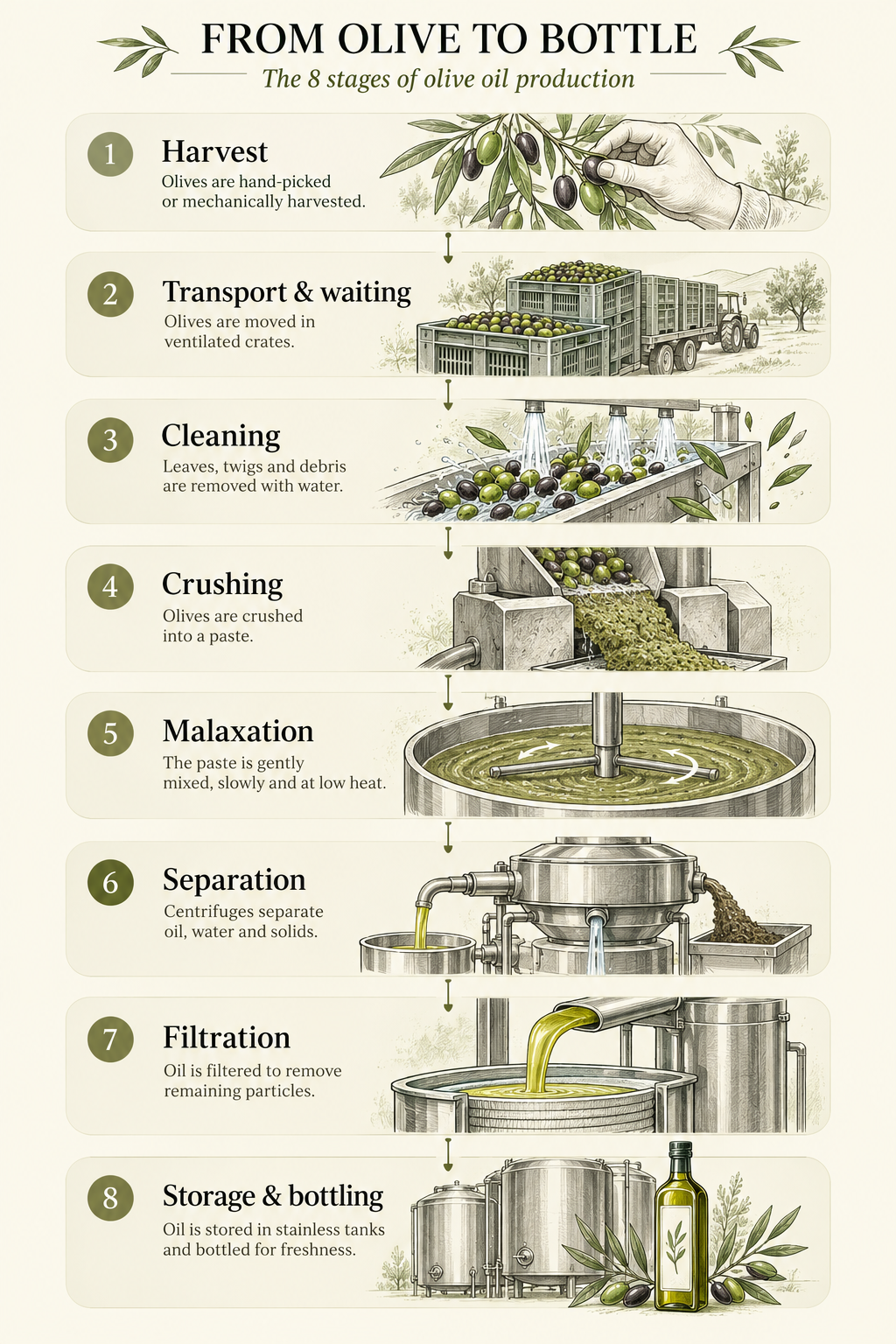
FROM OLIVE TO BOTTLE

From olive to bottle

The eight stages of olive oil production, from harvest to bottling.

FROM OLIVE TO BOTTLE

Explore the journey of an olive, step by step.

Eight-step olive oil production flow
PROCESS FLOW

Quality comes from the whole chain, not one step.

Fruit condition, harvest-to-mill time, malaxation, separation technology, filtration, and storage all work together. Doing one step well does not cancel the importance of the others.

Key hidden variable The time between harvest and processing often matters more than many consumers expect.
Quality trade-off Maximum yield does not always mean the best sensory profile or the highest phenolic structure.
What to look for Harvest year, cultivar, processing claims, the source of analyses, and storage advice.
01/08

Harvest

Ripeness and fruit condition form the starting point for oil quality.

02/08

Transport & waiting

Aim to avoid bruising, use ventilated crates, and process promptly.

03/08

Cleaning

Leaves, twigs, soil, and foreign material are removed.

04/08

Crushing

The fruit is crushed into paste containing oil droplets.

05/08

Malaxation

Slow mixing helps oil droplets coalesce; time, temperature, and oxygen matter.

06/08

Separation

A centrifuge separates oil, water, and solids. Two- and three-phase systems differ.

07/08

Filtration

Reducing residual water and particles can support storage stability.

08/08

Storage & bottling

Controlling light, temperature, and oxygen helps protect the finished oil.

The framework below is a practical guide for small and medium-scale premium production. Real optimum settings vary with cultivar, equipment, target style, and mill design. The sketches are intentionally kept in Turkish for consistency with the Turkish site.
Harvest aşaması çizimi
Aşama 01/08

Harvest

Oil quality starts in the fruit. Harvest timing, fruit health, and gentle picking all shape aroma, phenolics, and the risk of defects.

Minimum

  • Do not use olives fallen on the ground
  • Use ventilated crates
  • Get fruit to the mill within 24 hours

Best practice

  • Harvest during cooler hours
  • Aim for early / medium ripeness
  • Processing within 4–8 hours is ideal
Transport & waiting aşaması çizimi
Aşama 02/08

Transport & waiting

The time after harvest is one of the biggest hidden quality drivers. Compression, heat, and long waiting times increase fermentation risk.

Minimum

  • Use ventilated crates instead of sacks
  • Avoid deep piles and direct sun
  • Waiting time should not exceed 24 hours

Best practice

  • Deliver fruit to the mill the same day
  • Keep layers shallow with good airflow
  • Ideally move into processing within 4–8 hours
Sorting & washing aşaması çizimi
Aşama 03/08

Sorting & washing

Removing leaves, twigs, stones, and soil helps lower the risk of off-flavours and prepares cleaner fruit for the extraction line.

Minimum

  • Leaf separation should be done
  • Use potable water
  • Do not leave dirty water standing

Best practice

  • Also sort out defective fruit
  • Refresh the water frequently
  • Wash thoroughly but gently
Crushing aşaması çizimi
Aşama 04/08

Crushing

At this stage the olive becomes a paste containing oil droplets. The aim is to create a homogeneous paste while limiting heat and oxidation.

Minimum

  • Crush fruit promptly
  • Equipment should be clean
  • Paste should stay below 30°C

Best practice

  • Crush without delay
  • 22–27°C is a strong operating range
  • Keep oxygen exposure low
Malaxation aşaması çizimi
Aşama 05/08

Malaxation

Malaxation is the slow mixing stage that helps tiny oil droplets combine. Time, temperature, and oxygen define the balance between quality and yield.

Minimum

  • Often kept in a 20–45 minute range
  • Paste temperature should stay below 30°C
  • Avoid excessive air contact and long delays

Best practice

  • 22–27°C is often better for premium styles
  • Prefer controlled shorter times over unnecessary extension
  • Closed systems with low oxygen exposure can support quality
Separation aşaması çizimi
Aşama 06/08

Separation

The decanter and separator line splits the paste into oil, water, and solids. Water addition, machine cleanliness, and settings all matter here.

Minimum

  • Flow should be stable
  • Separation should finish promptly
  • Phases should split clearly

Best practice

  • Keep added water to a minimum
  • Maintain very clean equipment
  • Aim for low oil loss
Filtration aşaması çizimi
Aşama 07/08

Filtration

Filtration helps reduce suspended water droplets and fine particles. That usually improves stability and storage performance.

Minimum

  • Visible sediment and free water should be reduced
  • Filters and lines should be clean
  • Avoid recontaminating the oil afterwards

Best practice

  • Plan filtration without long delay
  • Keep oxygen exposure low
  • Aim for a clearer, more stable oil
Storage & bottling aşaması çizimi
Aşama 08/08

Storage & bottling

Even a well-made oil can lose value quickly if it is stored badly. Oxygen, light, temperature, and filling hygiene are the key themes of the final stage.

Minimum

  • Prefer stainless steel or light-protective packaging
  • Provide a cool, stable environment
  • Minimise headspace and bottle oxygen

Best practice

  • 14–18°C stable storage is often ideal
  • Inert gas headspace management is beneficial
  • Use dark glass or tin and bottle cleanly and quickly
THE QUALITY JOURNEY

Good oil is not made by one machine.

When evaluating a producer, it is not enough to look at one claim such as “cold extraction”. Harvest discipline, access to the mill, filtration decisions, and storage hygiene should be read together.

Why do people talk about 4 hours? →

Cultivars matter too

Memecik, Ayvalık, Gemlik and other local cultivars are a good way to understand how the same process can lead to very different flavour profiles.

Explore local cultivars

Sources: Rotondi et al. (2021), Marx & Priego-Capote (2025), Frangipane et al. (2023), plus ZeytinCheck working notes. No single step guarantees final quality.